06 / 06
Data science
Climate × Agriculture
A two-notebook study that clusters 10,002 climate-agriculture records, then predicts crop yield with Random Forest and Gradient Boosting.
- Role
- Solo, analysis and visualisation
- Year
- 2025
- Stack
- Python · Pandas · scikit-learn · Matplotlib · Seaborn · Jupyter
- Reading time
- Project note
- Team
- Solo project
01 · Overview
What it is
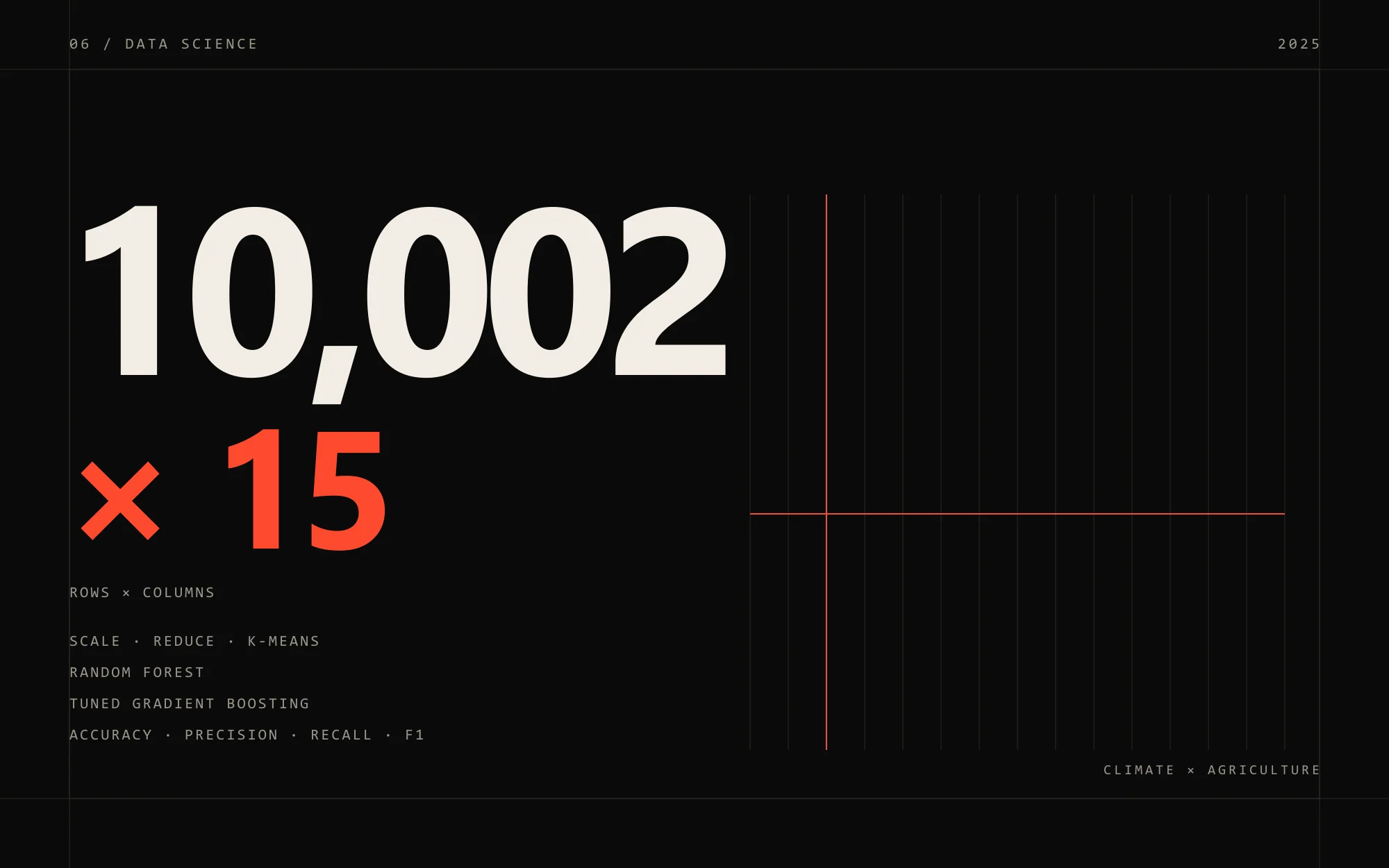
A two-notebook study that clusters 10,002 climate-agriculture records, then predicts crop yield with Random Forest and Gradient Boosting.
An unsupervised pass first: scale the features, reduce dimensions, tune K-Means and read the clusters. Those clusters become the label for a supervised pass that compares Random Forest against a tuned Gradient Boosting model across accuracy, precision, recall and F1.
02 · Highlights
Highlights
- 01
K-Means clustering with feature engineering aimed at the silhouette score.
- 02
Random Forest versus tuned Gradient Boosting, compared on four metrics.
- 03
Dataset: 10,002 rows × 15 columns from Kaggle, preprocessed with a scripted pipeline.
- 04
Pinned on the GitHub profile.
03 · Stack
Stack
- Python
- Pandas
- scikit-learn
- Matplotlib
- Seaborn
- Jupyter
Sources
- climate-agriculture-ml-analysis - repository READMEOpen (opens in a new tab)
- Eksperimen_SML_Zidan-Mubarak - preprocessing and CI repositoryOpen (opens in a new tab)
- GitHub profile - github.com/zidanmubarakOpen (opens in a new tab)